- Born 15 September 1818, daughter of Rev. William Marsh (1775-1864) and Maria Chowne Tilson (1776-1833).
- Friendly with the Elliott family, in particular Arthur Wilmot Elliott (1841-1862) and Rev. Julius Marshall Elliott (1841-1869).
- Died 12 December 1912, aged 94. Buried in Upshire, Essex.
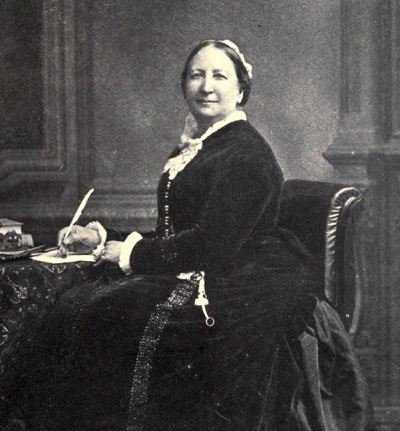
Details about her father and family are also given at http://www.thepeerage.com/p3476.htm#i34756.
Mentions in Emily's memoir
p22
"The well known agéd Divine, Dr. Marsh, was then living with his family at Beckenham Rectory, in Kent; and his daughter, Catherine Marsh, a woman of great and consecrated powers, was one of the first ladies who braved public opinion, and took up Evangelistic work as a preacher amongst navvies, then engaged in constructing a Railway in North Kent. The account of her remarkable work amongst this fine, albeit rough, race of men, is told in 'English Hearts and Hands' by herself. Her Sunday evening meetings in the "Barn" for these men, was thrown open also to the young Addiscombe cadets - who thought little of the three mile walk when they found such a warm welcome ever ready for them from this dear and excellent family - the Marshs and Chalmers. And here it was that dear Arthur first read his title clear, and full of youthful zeal and fire, set himself to win his brother sub officers, and cadets for the Lord. His plan was to concentrate prayer on one man until he was converted, and then on another, and when possible to get one in sympathy in the College to join him in prayer."
p27
"Dear Miss Marsh came down during this summer, and addressed, a large gathering of our poor people on the lawn. She gave away many of her delightful little books - and quite recently I found one of these on a shelf in a cottage at Tattingstone. Our dearest Mother, who now met Miss Marsh for the first time, thanked her warmly for all the help she had been to our Arthur - to which that great soulwinner replied "Don't thank me, my dear Mrs.Elliott! I was only the poker who stirred the fire that you had laid by long years of prayers." Words of noble disinterestedness - and of undoubted truth. How encouraging to every praying Mother!"
"I remained with our dear friends Mr. and Mrs. Austen, at West Wickham Rectory, Kent, for 9 months; and she was glad to have a 'daughter' about her - as their only child had married Dr. Cartmell, Master of Christ's College, Cambridge. West Wickham is an ideally pretty English village - and Wickham Court on rising ground close to the Church, both in view of the pretty Rectory, is of historic interest – Henry VIIIth having courted the unfortunate Anne Boleyn there. The neighbourhood is well known for its beauty; Hayes Common, Keston Common, and Bromley and Chiselhurst all lying within six miles, we could not walk anywhere, or drive, without lovely scenery. I have never enjoyed spring time so much as in that peaceful spot; and have a vivid remembrance of the glory of the white and pink and red {p28} trees in full bloom on Heyes Common-- and the chorus of cuckoos answering one another on different notes from different parts of the common; and of nightingales who sang all day and all night over their mates' nests. Wickham is only 3 miles from Beckenham, and 3 from Addiscombe - they formed in fact a triangle - and we were often at both places; especially the former, as Mrs. Austen was a cousin of Miss Marsh's. Just about this time Miss Marsh moved with Dr.Marsh to Beddington Rectory; which he held for five or six years until his death. This village was again three or four miles from Beckenham - and à propos the atmosphere of the three different Homes, we called Beckhenham 'LOVE' - Beddington 'JOY' - and West Wickham 'PEACE'!"
p32
"Throughout the day he [Arthur Wilmot Elliott (1841-1862), on his deathbed] repeatedly took his pocket Bible, Miss Marsh's gift, and read portions aloud to us - such as Rev. XXII, Phil. III, and passing over Eph. VIsaid "the work is all over now." To our dear Mother he said "You did not think I should be first! But I'll be at the gate to welcome you, my Mother." Canon Hugh Stowellwho happened to be in the Hotel, came up for a few minutes, and prayed with him, and on leaving said 'Would that all in this Hotel could see how a young Christian can die!' We encouraged him to sleep a good deal, and once after a cup of broth when I was settling him comfortably for a doze, he turned and looked earnestly at me and said: "Darling - if I should go to sleep, and never wake again, you'll know that I have gone straight to Jesus! What a quiet passing away that would be, and what a glorious awakening to find myself with Him." And then he closed his eyes, and fell asleep evidently thinking he should never wake again.
Our Father, knowing that Miss Marsh would wish to hear of it, telegraphed to her 'Pray for Arthur's departing spirit - he is conscious - all is peace.' The answer came back "Tell him Jesus says 'because I live, ye shall live also' - nothing can separate us from the love of Christ. Tell him how we love him, and shall meet him." (This incident is mentioned by her in her life of her father - the well known Divine Dr. Marsh D.D.)."
Biography
The Life and Friendships of Catherine Marsh (1917) by Lucy Elizabeth Marshall O'Rorke, (online here)
The following sections are the main ones of relevance concerning the Elliott family:
pp203-204:
"To return to her life at Beddington. On the night of August 12th, 1862, just as family prayers ended, footsteps on the garden path, followed by tapping on the window,
startled those who were bidding their lingering good-nights. Catherine Marsh drew aside the curtains, and saw in the moonlight, a man holding out a telegram. It was from
Interlaken, where Arthur Elliott was staying with his family, and it was sent by his father: "Pray for the departing spirit of our Arthur, he is quite conscious. All is peace." She sent an answer which Arthur kept beside him as long as he lived. [c.f.*Memoirs of Emily Elliott p32]
After his departure she wrote of him to the cadets at Addiscombe: "For five years, since the day when he told me in my boudoir at Beckenham Rectory that there
he first believed in Jesus Christ as his own Saviour.
[Footnote: When Catherine Marsh was paying a short visit to Arthur Elliott's parents in 1860, his mother said to her: "How can I ever thank you enough for being such a help and blessing to my son?" and she replied: "Dear Mrs. Elliott, don't thank me. I was only the poker that stirred the fire you have laid by long years of prayer."] [c.f. *Memoirs of Emily Elliott p27]
I have never seen a trace of coldness or backsliding from that Saviour's love and service; and nearly the last words he said were, 'It is better to depart and be with Christ
-far better.'' His father wrote, 'God has taken from us the most blameless, most loving, most attractive of sons.'"
Arthur Elliott's health had obliged him to resign his commission in the Engineers; he was at Trinity College, Cambridge, intending to take Holy Orders, when this
fever ended his short, but bright, career on earth."
pp219-220
"Henry O'Rorke spent the winter in Italy travelling about with his friends, Mr. Laurence of Beddington and his son, the Rev. Percival Laurence. He returned to England in the early spring, and on April 20th, 1865, there was a double wedding from Beckenham Rectory, when Lucy Marshall was married to Henry O'Rorke, and at the same time Agnes, her youngest sister, Catherine Marsh's much loved niece, was married to Robert Macleod Hawkins, who had been ordained and was working with Mr. Chalmers.
Henry O' Rorke was going to St . Mary's Church , Brighton, which was to be held in charge for Julius Elliott, the youngest son of the late Incumbent, the well-known
preacher, Henry Venn Elliott, who though he had only once met Henry O'Rorke, sent the request when he was dying, that he would come to St. Mary's, and be a friend
to his son. Julius Elliott was dear to Catherine Marsh, she had many friends in Brighton and interests there, and as it was easy of access from Beckenham it helped to
lessen the trial of beginning life, for the first time, in a home without her father."
pp237-240
"The Brighton time drew to a close before their third year was quite completed. Julius Elliott, now in full orders, had come to take his father's place in St. Mary's
Church, but he asked Henry O'Rorke to stay on with him, and for a few months they worked together as an elder and younger brother would ; and Julius often sought
counsel of her whom he called his " mother friend." He had never known his own mother, as she died when he was an infant. Their letters show the fellowship of heart that united them.
C. M. to Julius Elliott:
"Your letter filled my heart with thanksgiving to our God. This is your first Sunday in your new sphere of duty. [Footnote: His first Rector was the Rev. Ashton Oxenden, afterwards Bishop of Montreal.] I am praying you may be kept very close to our Blessed Saviour, and daily and hourly have more of Him in your heart, on your lips, and in your life, and set the Lord always before you, and because He is at your right hand you shall not be moved.
"Not be moved from trust in the finished work of Christ alone for salvation, nor from dependence upon the guidance of God the Holy Spirit by His Word.
"Not be moved from the simplicity of Gospel statement, and of Evangelical practice and customs.
"Not be moved from the strength of Protestant feeling vitally important at the present time when the Papal encroachment is coming on like a cyclone wave, and
England is throwing down her sea-wall in the face of it.
"Do tell me what you have to do directly for souls face to face with them in sick- visiting, cottage readings, and prayer meetings, as well as your regular services."
Julius Elliott to C. M.:
"A thousand thanks for your lovely long letter. Did you ever feel when you wished to speak most warmly your words were coldest? I am feeling that sadly. Putting myself in the place of my audience, I could hardly believe that I cared for, or knew anything about those glorious truths which are everything to me.
"Could I not come to hear you address the 200 soldiers and their wives? I would sit 'in the dark,' or do anything else that might seem desirable, I want you to tell
me how you speak. May you be the means of bringing about our Lord's coming into many hearts."
C. M. to Julius Elliott:
"Easter Monday, 1865. Amidst the sorrowful memories of past Easter Days and amidst the rising hope of the nearing of the Great Easter Day one prayer above all
others fills my soul 'that I may know Jesus and the power of His Resurrection' above and beyond (unutterably) all I have ever yet known of Him or of that power. Let us ask that 'the spirit of Him who raised up Jesus from the dead ' may raise us up afresh to walk with Him in newness of Life. What fresh baptism of the Holy Ghost one needs day by day and hour by hour. Let us think that hour wasted (comparatively) in which we have not sought and found a draught of the Living Water (a drop, at all events).
"My blessed father used to say : 'Seek to do every act of service for your Master under a fresh, constraining sense of His Love.' And oh, for a lift up to a higher level higher and higher still where we may walk in closer 'Fellowship with the Father and with His Son, Jesus Christ,' and see through clearer air, the Face of the ' Altogether Lovely.'"
Julius Elliott to C. M.:
"It is Sunday night, I have been preaching from Romans X. 21: 'All day long I have stretched forth My Hands unto a disobedient and gainsaying people.' And knowing that what was written of the Jews, is also true of us, I rejoiced to throw myself afresh, and I begged my fellow-sinners to do the same into those loving outstretched Arms, and I loved to feel them folding me to His Heart, and cherishing me, I loved to feel them above me, sheltering me from all danger, I loved to feel the everlasting Arms underneath me, to support me under all trials.
"And when I had done preaching, it seemed to me as if I had told them nothing of God's love, so that I could find no comfort till I prayed your prayer, (do you remember
teaching it to me) : 'Blot out my blunders,' so you will see you have been with me today, and helping and blessing."
In the following year [1869] Julius Elliott went to Switzerland for some Alpine climbing. He was an experienced mountaineer, and would never be roped. On July 27th he and a friend, Mr. Phipps, went up the Schreckhorn. They had good guides, and Mr. Phipps was roped to his. That night he wrote to Julius's eldest sister, Miss Elliott, a letter of deep sympathy and he told her then, "I never saw Julius in such spirits, continually expressing his delight. He wished to go more quickly than I could follow, and he reached the highest peak, going with his marvellous speed. When I reached the 'Col,' and saw him above me, he greeted me with a shout, and then sprang to the rocks, from the snow. He slipped and fell it was a gentle slip, but he slid over the snow at an increasing pace. He tried in vain to stop himself, and to our inexpressible horror we saw him fly down the snow some 4000 feet.
"I have really loved your brother, and more and more admired his beautiful character it has been truly said of him, 'No man ever lived better prepared to die.'"
The search party found the body of Julius Elliott, lying on the snow as if in a peaceful sleep. In his pocket was his little well-worn prayer book, and inside it Catherine
Marsh's card of prayer for the year, which he had evidently used constantly for intercessory prayer for several friends whose names he had placed in smallest handwriting on the margin. His grave is in the churchyard at Grindelwald."
p243
"She had many new friends also, among these were Mrs. Gordon and her father Mr. Laurence Peel, with whom she had much in common, sharing their intellectual and
religious interests. There are many others who cannot be mentioned for lack of space, but the Elliott family must not be omitted: the Rev. Edward Elliott, the learned author of Horae Apocalypticae, and his wife and daughters, and his sister Charlotte, writer of hymns which are a treasure to the Christian Church, especially the
well-known one, Just as I am. She lived with her sister Eleanor, the wife of the Rev. John Babington, and they were a happy trio. After Catherine Marsh had gone, Charlotte Elliott wrote to her :
"Brighton has seemed stripped and desolate to me since you left it perhaps I was in danger of making an idol of you. One after another my bright stars disappear, and you my beloved friend were to me one of the brightest and dearest.""
Publications
English Hearts and English Hands: or, The Railway and the Trenches (1848) by Catherine Marsh (online here)
The Victory Won; a Brief Memorial of the Last Days of G. Reeve. (1860) by Catherine Marsh (online here)
Memorials of Captain Hedley Vicars, Ninety-Seventh Regiment (1856) by Catherine Marsh (online here)
The Life of the Rev. William Marsh D.D. (1868) by Catherine Marsh (online here)
pp258-259
"On the 12th of August a telegram reached the rectory from the father of one who had been amongst the most devoted of the young Christians at Addiscombe. The telegram only said, 'Pray for the departing spirit of our beloved Arthur. He is quite conscious. All is peace.'
It was the first intelligence of his illness which had reached my father, and it deeply touched him. He had remarked the rapid ripening of the youth from the day when—trained from infancy in Scriptural knowledge, and blessed with the unceasing prayers of a tender mother—he had, at Beckenham Rectory, believed on the Lord Jesus Christ with the heart unto righteousness, and had gone forth 'to confess Him with the mouth unto salvation,' amidst his companions at a military college.
From that hour, sensitive as he was to an almost feminine degree, the brave and faithful spirit of that young soldier never flinched. To those who watched him closest, it seemed that he never even wavered, but that his light grew brighter and brighter until the sun of his earthly life went down at noon.
Delicacy of health obliged him to resign his commission as first engineer of the term, just as he had taken the highest honours of the college. After a time he turned his thoughts to studying for Orders, and matriculated at Trinity College, Cambridge, where, during his brief career, he was remarked as being 'pre-eminent amongst the number of those who deserve the name of consistent and happy Christians.' Wherever he went, during the vacations, his society was felt to be an influence for increased holiness and earnestness. At once he sought to be employed in visiting the sick, and constantly conversed with those of his own age on the subjects nearest his heart; and he has been known to give up travelling in the same carriage with his own friends, in order to carry on a conversation with a third-class passenger, begun on the platform of the railway-station, that he might press upon his companion the blessedness of choosing the Way of Life.
When he was seized with fever at Interlachen, he said to his devoted mother, 'It is better to depart and be with Christ—-far better.' So dear was the Bible to him, that he would fall asleep, at times, with it clasped in both hands. On one occasion he said to his French nurse, 'Je suis tresmalade. Je suis pauvre, miserable pe'cheur, mais par l'amour de Jesus Christ qui est mort pour nos pe'che's, je serai sauve'. The last three words she described him as saying most earnestly, with clasped hands. Then he ended by repeating the words, 'Le sang de Jesus Christ nous nettoye de tout pe'che.' And when the names of father, mother, and sisters fell on an unconscious ear, the name of Jesus lighted up his face with a radiant smile. So passed away the spirit of Arthur Elliott into the presence of that Saviour whom he had so early sought and so early found."